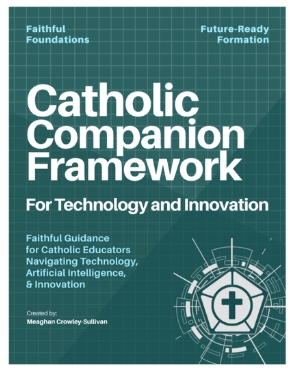
Published in 2025 by Meaghan Crowley Sullivan of LMU’s iDEAL Institute, The Catholic Companion Framework For Technology and Innovation: Faithful Guidance for Catholic Educators Navigating Technology, Artificial Intelligence,& Innovation seeks to be “an invitation to reflect, to engage, and to act” in our Catholic community (4). It is certainly a solid initial first step in how our schools and educators can engage with the problems and solutions AI presents.
Before diving in, two disclosures. I have taught in LMU’s Catholic Leadership program – though not directly affiliated with the iDEAL institute, I know many members from my time in LA. In addition, Meaghan and I know each other from our time in ACE Teaching Fellows at the University of Notre Dame.

What’s in it
The document centers its presentation of guidance in the moment. This is one where “innovation can open extraordinary possibilities…but its impact depends on the intentions of those who design it and the choices of those who is it” (5). The question is focused on “how we [educators] will guide that influence, ensuring that technology is oriented toward wisdom, responsibility, and faith rather than left to the values of the marketplace along” (5). Citing recent studies from Inside Higher Ed, Digital Education Council, and Common Sense Media, a clear need for guidance is articulated. The framework aims to do so “rooted in something stronger than the pace of innovation and the pressures of society” (8), drawing from the Catechism, Catholic Social Teaching, the Magisterium, and the writings of the saints and Church as a whole.
This leads to the creation and presentation of five anchor strands, which “name a central truth of Catholic teaching and applies it to the evolving landscape” (10). These are:
- Imago Dei – the nature of mankind and human dignity w/r/t AI and the digital world
- Co-Creation & Stewardship – creating with purpose and appropriate stewardship
- Moral Conscience & Discernment – how can we grow in virtue and choose the moral good
- Communion & Solidarity – joining with and including individuals digitally
- Wonder, Mystery, & Awe – what can technology not replace
These five then serve as a basis for a series of substrands [sic] and instructional goals that are “concrete expectations across grade spans, from ‘Before Kindergarten’ through ‘Higher Education’” (12). These are presented in grid form, with five main ideas under each anchor, detailed across six development/academic tiers.
The document concludes with an invitation to the broader community to consider and develop these as the moment grows.
What’s not in it
The framework – purposely – leaves out much discussion of how teachers and educators can and should use AI in the course of their own practice. These issues are addressed to greater depth in the various documents released at the state, local, and (for Catholic schools) diocesan level. A consideration of how AI tools in planning, assessment, grading, and teaching affects the relationships and trust of the student-teacher-family triad is worthy of consideration and possible inclusion in future documents. AI – by its nature – will change more than what skills and understandings our students need; but requires crash course consideration for our teachers and leaders as well.
The standards themselves are relatively basic, echo religion standards from various dioceses, and aim to connect them to technological concepts. A deeper linking to current religious instruction would be helpful. Here, I see a specific need for articulated and graduated understanding of the nature of mankind as rooted in the Theology of the Body. With that aspect linked closely to a “Theology of the Mind” – enabling a philosophical and theological understanding of the true nature of man and embodied consciousness versus that of exotic mind-like entities.
This same additional layer of depth could help construct not just the presented conceptual sub standards presented, but opportunities for Catholic application and skill development. These skills are delineated in other frameworks, a Catholic approach might include, adapt, or exclude various specific skills depending on their moral basis. A perfect example is the ongoing discussion over the use of generated icons for prayer or digital art. Is the depiction of a saint less moral if created by a generative AI than by human artist. How does economics and talents affect this consideration?
Lastly, applying a concrete series of grounded ethical considerations would enrich the framework. Leon Furze’s free course is a great example of how we can push educators and students to think deeper about AI. Imagine expanding this to include a truly Catholic worldview – incorporating many of the sources which serve as the basis for the framework itself.
Like Meaghan Crowley-Sullivan, I see this document as a needed first step – articulating a basic approach and path that “is a companion, one that walks beside Catholic schools, parishes, and families as they discern how to support students and live faithfully in a digital world” (20). I encourage school and church leaders to pick up, read, study, and reflect on the framework as they develop policies and procedures in their communities around artificial intelligence.
Leave a Reply