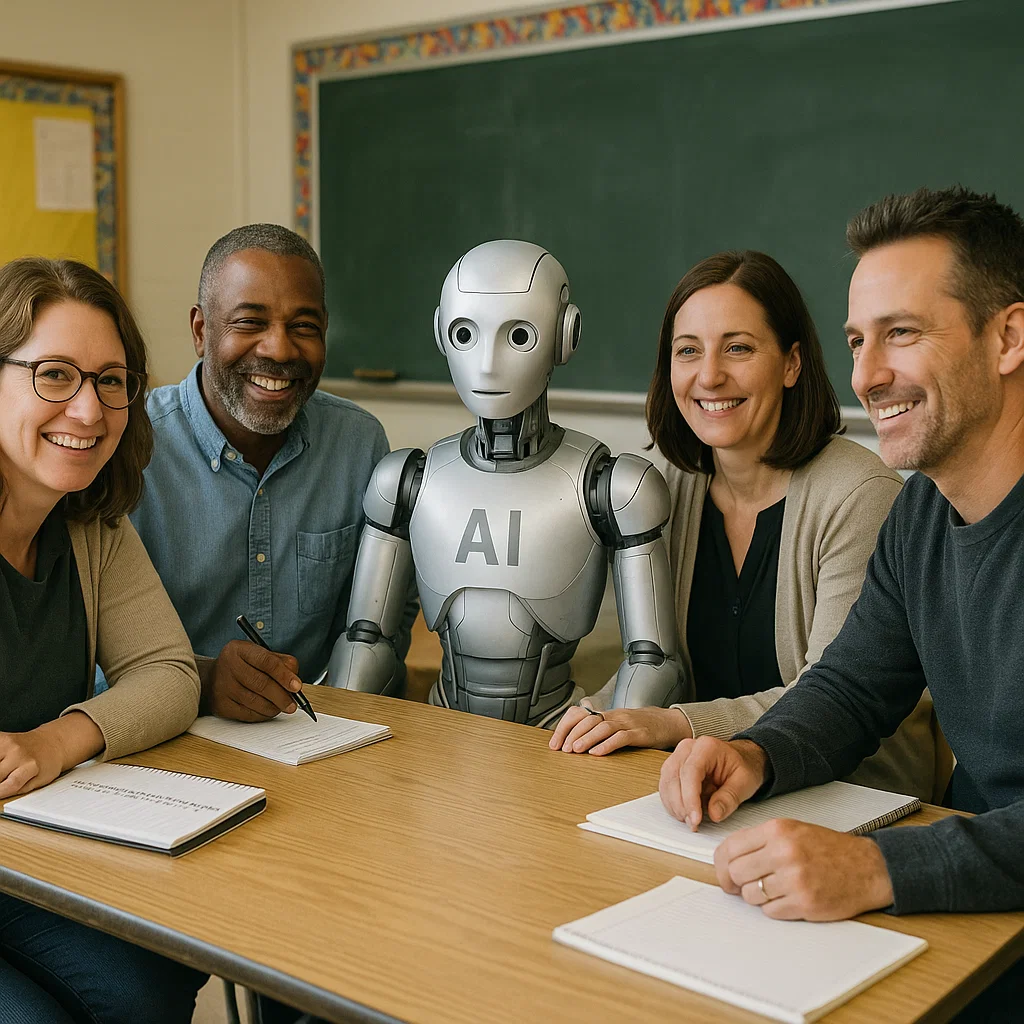
Harvard Business Review published a guide to using AI in team meetings: “3 Ways AI Can Improve Team Meetings.” Elisa Farri and Gabriele Rosani present three basic ways where plugging AI in can improve outcomes: for meeting prep, as a participant, and as a tool for all attendees.
The before meeting recommendations include having participants engage with prompts centered on meeting topic or simulating the meeting or dynamics. During the meeting, AI can serve (especially in voice mode) as a challenger, expert, articular, or planner. Lastly, AI can be used by all participants for personalized reflection and brainstorming. This last one has the added benefit of the individualized context from users and a safe space for ruminations.
Moving from the corporate sector to the educational sector – this approach has great promise for PLCs. Let’s focus on two today: (1) using AI as a partner in the PLC and (2) using AI with individualized manners.

PLCs serve a vehicle to ensure that each student is getting the academic and social support her or she needs to meet their goals. Teachers come together to collaborate with a focus on using data to discuss refinements and enshrinements in current process and systems. AI can be a great contributor here especially as an add-on for human intelligence.
First, as a “member” of a PLC, AI can be used to analyze the data teachers bring to the table. School leadership can prepare prompts for use by each PLC that can help notice trends in anonymized student data (or using a secure tool), provide next steps or strategies based on the data, or evaluate ideas presented by the team members. By pre-providing prompts, each PLC receives similar jumping off points and team members that are less comfortable with AI receive additional support.
Second, as a “thought partner” for each member of the PLC, AI can provide specific and individualized feedback on strategies that teacher has implemented and the data that has driven and resulted from such interventions. It helps remove the human judgement angle that a wide-ranging conversation might include – especially for struggling teachers. At the same time, by placing these conversations in a broader setting, we can ensure a collaborative approach.
School leaders should provide prompts and a designated time segment for individual use – for example – ten minutes using a prompt such as:
You are an instructional data coach using MTSS.
Context:
– Grade/Subject: [e.g., 6th Grade ELA]
– Priority standard/skill: [e.g., RI.6.1 cite textual evidence]
– Time window: [e.g., Aug 15–Sept 5]
– Assessment/data type (paste de-identified table or brief summary):
[PASTE TABLE with columns like: Student_ID | Subgroup(s) | Score/Level | Item_Tags | Attendance | Notes]
Task (be concise):
1) List 3 strengths and 3 gaps you see, with 1 sentence of evidence each.
2) Name any subgroup patterns (≥10% difference).
3) Propose 2 plausible root causes: one instructional (e.g., task design, feedback, practice), one non-instructional (e.g., attendance).
4) Give 3 “evidence to collect next” questions for the PLC.
Output limits:
– Bullet points only
– ≤120 words total
Following this ten minute work session, the team could reconvene and reflect on the output and ways to improve it and further personalize it for their students and selves – a great time for more experienced teachers to step forward and refine the basic output.
This simple step forward is a way to bring a whole faculty forward as a team and in an outcome-oriented way to drive implementation of AI while doing so in a human-forward way.
Leave a Reply