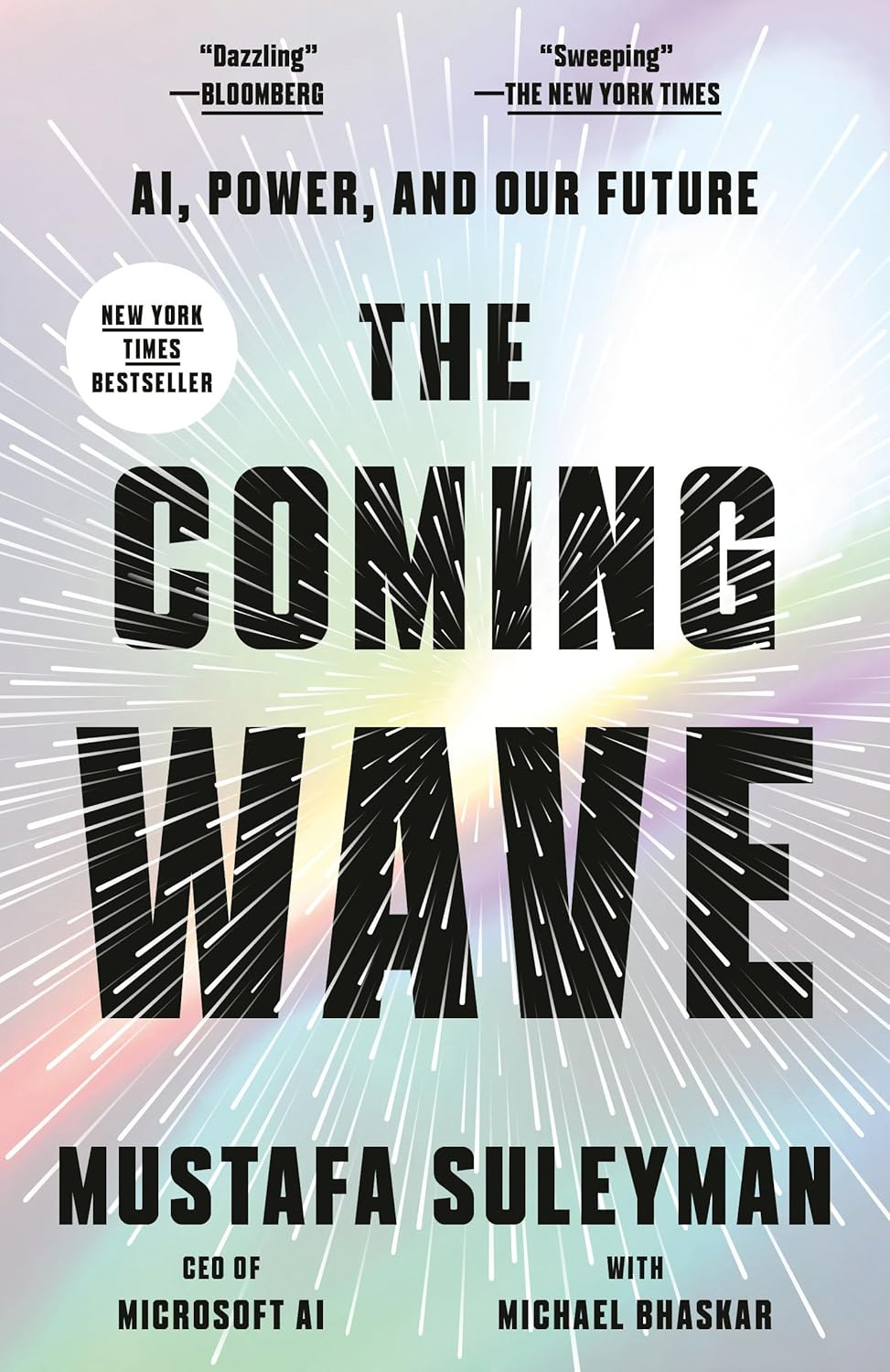
This week’s review is on The Coming Wave: Technology, Power, and the 21st Century’s Greatest Dilemma by Mustafa Suleyman with Michael Bhaskar.
A softer version of If Anyone Build It, Everyone Dies, Mustafa Suleyman makes the case that the era of AI and biotech holds great promise but numerous pitfalls. But while Yudkowsky and Soares call for a moratorium on AI development, Suleyman suggests a combination of regulation and advocacy to delay Armageddon. This could be because his apocalypse speaks more to the diffusion of AI and biotech leading to uncontrollable plagues, disasters, and hacking with a tool that moves cataclysmic harm from the size of a nuclear weapon to that of an internet based device attached to a 3D printer. The danger is less the advent of AI itself and more what malicious actors can do with it.

Divided into four basic parts, the book is a walk through a basic history of technology, an investigation into the power of AI and biotech, the problems inherent in the current world systems, and a wave “through the wave.” Given the drama of the earlier history, the fourteenth chapters end with a tepid path forward; leaving the drama for the true doomers. Part of this might be his own roles starting DeepMind (now Google) and currently leading AI at Microsoft – it doesn’t get more insider than that 2/7 of the Magnificent 7.
Clearly intelligent but lacking in historic detailed knowledge, Suleyman’s core analogy is the way technology forms a wave within societies and economies. The way technology grows and swells presents “the core dilemma: that, sooner or later, a powerful generation of technology leads humanity toward either catastrophic or dystopian outcomes” (11). The twin technologies of AI and synthetic biology are what lies behind this current wave. These are the latest manifestations of “general purpose technologies” or those that “enable seismic advances in what human beings can do” (26), such as electricity, fire, stonework, agriculture, et al. These waves are deeply tied to population growth, urbanization, and economics – where “demand and the resulting cost decreases, each of which drives technology to become even better and cheaper” (31). The book then aims to understand the unintended consequences and deal with a containment problem where we cannot have “the overarching ability to control, limit, and, if need be, close down technologies at any stage of their development or deployment” (36). Where the violence of nuclear weapons has been curtailed through international treaty, small scale war and actions, and the difficulty inherent in constructing and launching devices; the coming wave cannot be dealt with so easily.
The first section looks at this in depth (arguable the whole book is too long for a relatively simple argument). Because “technologies are ideas and ideas cannot be eliminated” (41), we must seek a multitude of strategies to contain the current wave. Technology follows a pattern where it is “proliferating, cheaper, and more efficient” over time so that “it survives and spreads and those features compound” (47). Suleyman calls AI and synthetic biology one of these and spends a great deal of time discussing them and his experience with the two fields. This wave is one centered on power in this case “acting on it” (versus the media/Internet’s wave of broadcasting it) (102). This link to power also allows critique of corporatization and China.
For Suleyman, the genie cannot be put back in the bottle due to an in ability to ignore the financial and power aspects of the two technologies. Tied with this is the limited ability of the modern nation-state to take action. Not only are our governments to some extent slow and dysfunctional, but corporations are “empires of a sort, and with the coming wave their scale, influence, and capability are set to radically expand” (186). This ultimate challenge leads us with a difficult series of choices.
Suleyman’s book then offers up ten actions – which seem like throwing pebbles at an onrushing elephant. First we must recognize the problem and then confront that fact and begin taking steps to change the world to deal with it. These ten move from international treaties and regulation to increased ethics funding and personal action. Some are being set up at the national, corporate, or state levels. Most of them are described but rarely are actual steps presented. Such an extension – answering the question of “what can the common man do?” seems beyond the author. He can’t advocate not using AI, because that would jeopardize Microsoft. So pray and push for regulation becomes the shrug of an answer.
Of course can’t end without a reference to the Luddites. So Suleyman interprets this historical example as a need “to claim the benefits of the wave without being overwhelmed by its harms. The Luddites lost their campaign, and I think it’s likely that those who would stop technology today will, once again, not be successful. The only way, then, is to do this right, first time.” (283). So, please mail a copy of this book to your legislator.
Some of the more fascinating aspects are little asides. Suleyman’s “modern Turing Test” of having “an AI being able to successfully act on the instruction ‘Go make $1 million on Amazon in a few months with just a $100,000 investment” speak to a powerful tool to measure AGI, especially given his history in the field. Likewise, his insights into Quantum Computing as a boost to the development of AI and biotech could be prescient.
This week’s review is on The Coming Wave: Technology, Power, and the 21st Century’s Greatest Dilemma by Mustafa Suleyman with Michael Bhaskar.
Rating: 3/5 Stars
Good For: An argument for regulation.
Best nugget: We are probably screwed.
Please note: As an Amazon Associate I earn from qualifying purchases. However, I am not paid to provide reviews or use content.
Leave a Reply