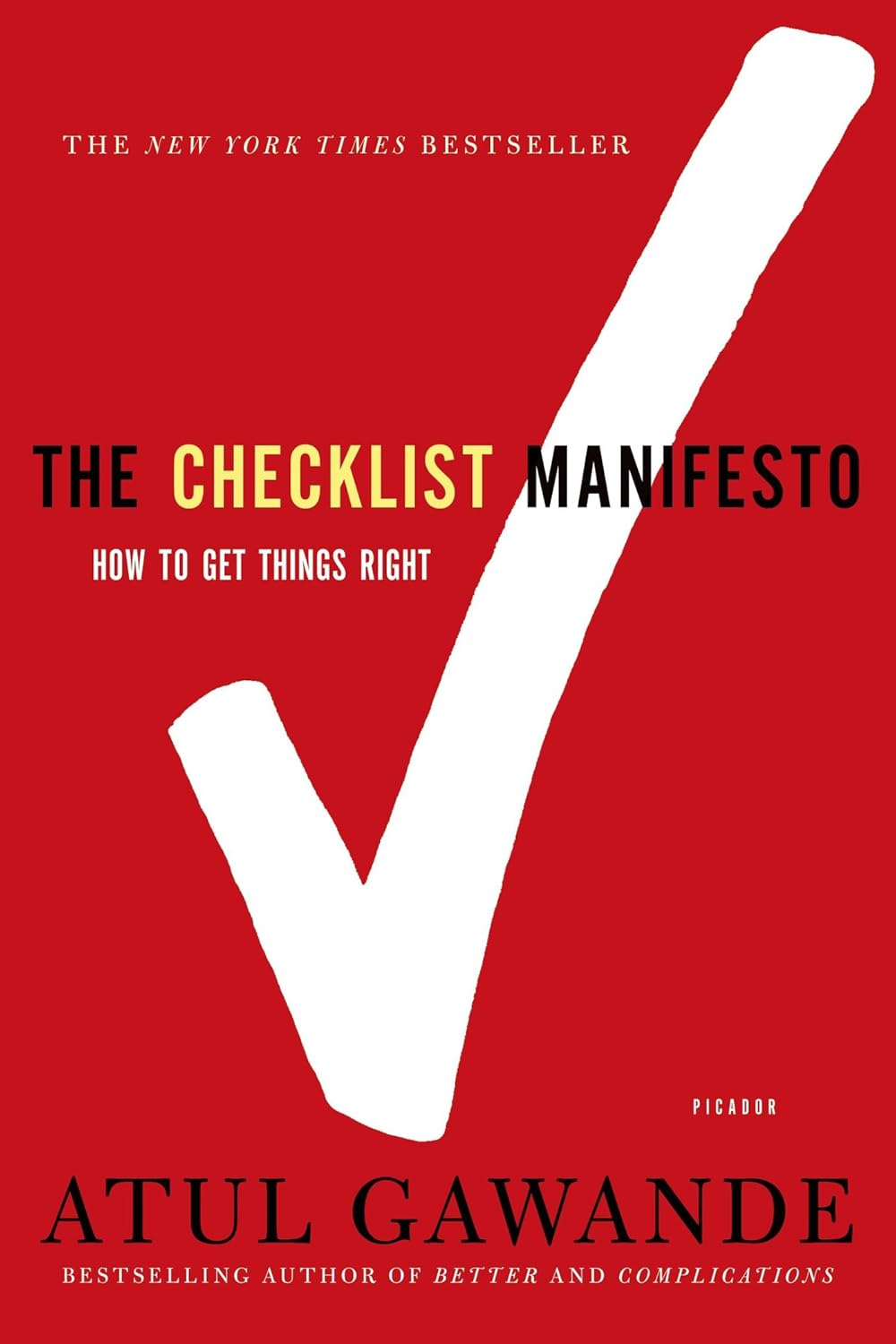
This week’s review is on The Checklist Manifesto: How to Get Things Right by Atul Gawande.
Rooted deeply in the lived medical experience of Gawande, The Checklist Manifesto, offers a somewhat unfocused examination of a simple tool. The book certainly feels aimed at the medical/surgical community in accepting the innovation Gawande himself participated in creating. The core idea of the checklist is also explored within the fields of flight and finance. How applicable such an idea is to the day-to-day of an educator is something I’ve dwelt on since finishing it.

Based in an article by Samuel Gorovitz and Alasdair MacIntrye in 1975 (“Toward a Theory of Medical Fallibility“), Gawande’s quest is focused on addressing the failures of the medical realm. These happen because of (1) ignorance – a lack of understanding of the complex systems we deal with on a daily basis or (2) ineptitude – we fail to apply our knowledge and experience properly. Such a delineation in a hyper specialized world is needed as science and understanding progresses where our errors predominantly lie in the latter, not the former. Unfortunately, education still seems to be one of those fields where ignorance and not complexity dwell.
For medicine and Gawande, “we live in the era of the superspecialist” (29), while educators certainly seem more and more called to deal with a wide range of aspects and children. At the same time for leaders, the point that “substantial parts of what…[we] do are now too complex for them to carry out reliably from memory alone” (34). Unlike most of the characters in the book, the idea of a checklist is inherently appealing – offering common ground to practitioners and ensuring that there is minimal system failure. Gawande uses small scale studies, data points, and analogies to build a “why” for the checklist; but the idea of a mapped out routine is a key element of education already.
The conversational aspect of running through a checklist is highlighted as well. By discussing the steps – input and blame are shared and create a more level playing field. For doctors and nurses this is a “subtle culture shift” (100); while for a project manager on a build site, it ensures common understanding. In such cases, it is key (for teachers and staff as well) that “we need them to see their job not just as performing their isolated set of tasks well but also as helping the group get the best possible results” (103).
The added benefit of a checklist is that it maps out a system and offers chances for consideration of what is key, agreed upon, or disregarded. The creation of the checklist, therefore, can be an essential summer task for a school-year tool that enables an administration (or staff, PLC, et al.) to discuss what matters and build consistency around the systems that keep a school operating. The key here is addressing the twin issues of (1) “the fallibility of human memory and attention” and (2) skipping steps even when they remember them” (36). Keeping a routine when the routine is known can sometimes be more difficult then establishing it itself (ask any teacher in May).
Checklist creation is a focus later in the book and Gawande splits them into “DO-CONFIRM” and “READ-DO” both of which should have between five and nine items. The former involves “team members performing their jobs from memory and experience…then they stop…run the checklist and confirm.” The latter is “more like a recipe” where “people carry out the tasks as they check them off” (123). This divide strikes me as a natural evolution of experience; with an office member learning from READ-DO before checking their work with DO-CONFIRM. Such an evolution is not discussed in the text.
Either route speaks to tradeoffs – in this case – between brevity and effectiveness. As anyone who has established classroom routines or procedures knows, creating too many or too complicated systems can grind things to a halt. Too few, however, and a lack of organization and focus can arise.

The penultimate chapter then dips into a greater sense of the importance of a simply checklist. Using Captain Sully as a model (as all good public servants do), Gawande highlights that a checklist helps us understand “how to function in a complex and dire situation” enabling an adherence to “vital procedures when it mattered most” (182). This then is the greatest argument for a mapped out and simple checklist – it serves as a reference for the mundane and exceptional.
The Checklist Manifesto: How to Get Things Right by Atul Gawande.
Rating: 3/5 Stars
Good For: An argument for a checklist, especially in medicine.
Best nugget: Checklist creation and discussion leads to a culture shift of more ownership.
Please note: As an Amazon Associate I earn from qualifying purchases. However, I am not paid to provide reviews or use content.
Leave a Reply