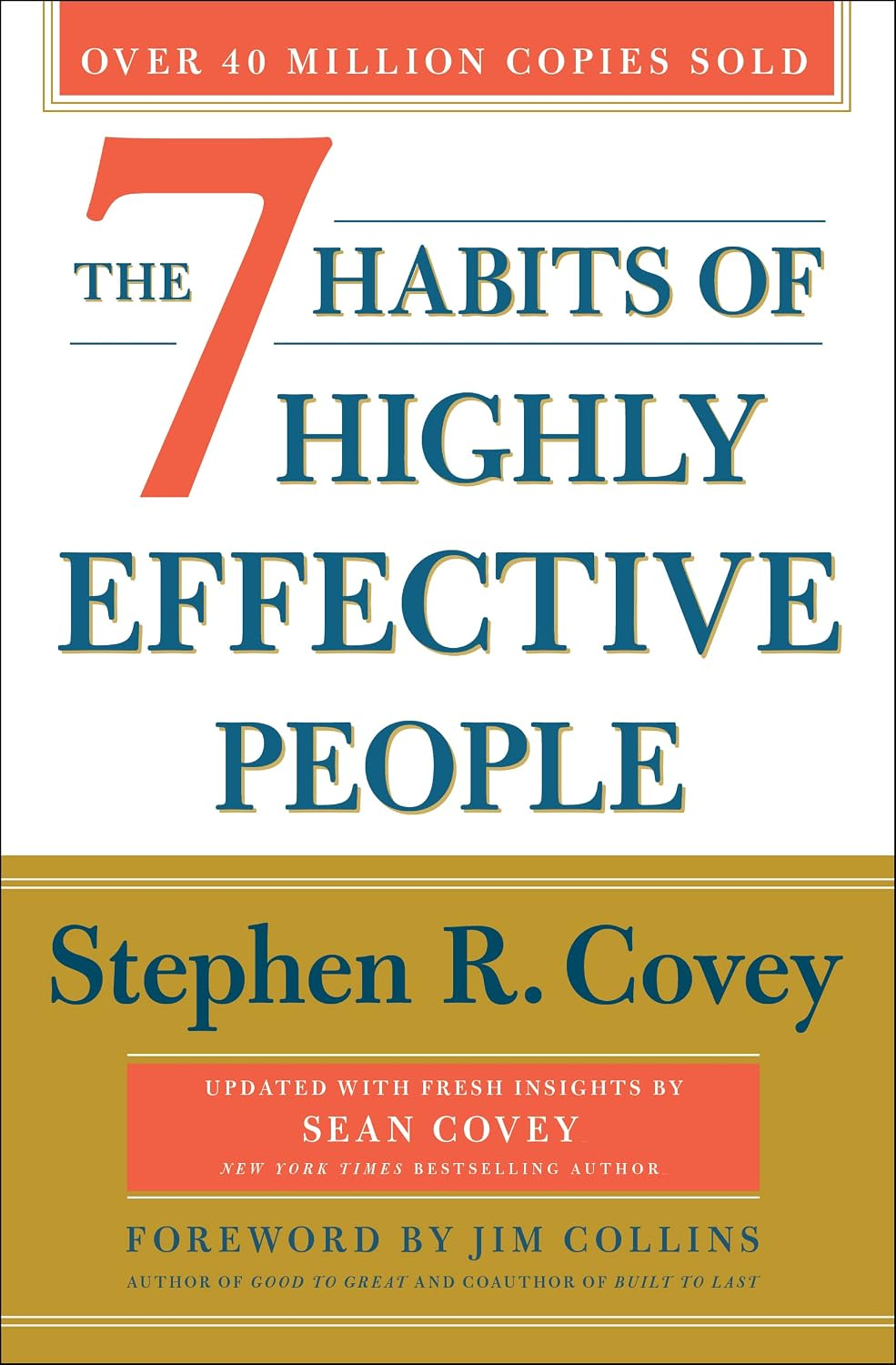
This week’s review is on The 7 Habits of Highly Effective People by Stephen R. Covey.
A touchstone in personal system/self-help literature, The 7 Habits of Highly Effective People may not be revolutionary but this simple read is helpful to those seeking to move from reactive to proactive. The advice Stephen R. Covey shares is worth a good reminder and can serve as thoughtful fodder for powerful reflection; especially for those of us in mission-based positions.
The edition I have includes a foreword by Jim Collins and notes from Stephen’s son and successor, Sean, but there are numerous versions of this text. Collins’ words connect his focus on corporate synergy with ” a similar pattern in personal effectiveness: first build upon a strong core of principles that are not open for continuous change; at the same time, be relentless in the quest for improvement and continuous self-renewal” (3). Covey likewise uses numerous personal and corporate examples to illustrate these points.

This book follows a simple structure and is full of readable prose that makes it an easy task to follow. Part One introduces the concept and provides an overview. Part Two highlights the first three habits – focused on “private victory” and discernment. Part Three is the outward facing, intrapersonal habits. Part Four concludes the text with the seventh habit of renewal and some reflection. This flow and some “tasks” at the end of each chapter enable the reader to grow with the text and cleanly begin implementation of the habits.
The key phrase of “inside-out” reflects Covey’s approach to habits. By building the inside, the effectiveness can grow out of us to our interactions with others and the wider world. Covey anchors his approach in what he names “Character Ethics” rather than “Personality Ethics” – this is the inside that influences the outside. The inside is marked by two main categories – realities and values – or the way things are and the way things should be (24). Changing these underlying maps changes the attitudes and behaviors that grow out of them.
The underlying maps are values. When these align with “correct principles, we have truth” (35). Principles are stronger – almost natural laws – that are deeper and point to the proper way to act. Forming habits to move our values closer to principles thus requires effort and work and the right timing. These habits are “the intersection of knowledge, skill, and desire” or “what to do…how to do…and want to do” (47). When we are properly mature, we move from dependence to independence, and end at interdependence (or you to I to we) (49). We cannot progress in that way until we know ourselves and move into alignment there. The effectiveness is a function of these habits and the “P/PC Balance. P stands for production of desired results…PC stands for production capability” (54). We must balance the short term with the long term – taking out our P after building up our PC and being sure not to overdraw (or neglect work at all).

[Sean Covey adds the 7 Habits of Ineffective People at the end of this chapter which provides a nice illustration and counterpoint to the 7 habits. He lists React; Begin with Squat in Mind; Put First Things Last; Think Win-Lose; Seek First to Talk, Then Pretend to Listen; Be an Island; and Burn Yourself Out (67-68)].
The first habit is being proactive. Rooted in the idea that we choose our reactions even if our liberty is denied. A proactive nature entails focusing on our response to stimulus – how we dive into our self-awareness, imagination, conscience, and will to move forward in a given situation (77). Continually reacting becomes a self-fulfilling prophecy and a cycle of blame can kick off. Rather than focusing on efforts of concern – Covey’s advice is to begin by focusing on what is controllable (ourselves and what we have power over). This is great advice especially for educators – our ability to influence children relies on recognizing what we have direct control over, indirect control over, and no control over (93). Once that is determined, we can act properly – keeping commitments as needed and working with the consequences and mistakes of such actions.
Habit two is setting a clear goal – or beginning with the end in mind. By starting with a “mental or first creation” (113) we can design and act with intention. Covey draws a nice comparison between Leadership (setting the goal) and Management (getting to the goal) that echoes findings in Change Management and other seminal business books. A big part of this is developing “a personal mission statement or philosophy or creed. IT focuses on what you want to be (character) and to do (contributions and achievement) and on the values or principles upon which being and doing are based” (120). This centers our efforts – for such a goal “will be the source of our security, guidance, wisdom and power” (or sense of self, source of direction, perspective on life, and faculty to act) (123). Covey spends a long time pointing out alternative centers other than one that is based on principles. But a truly aligned approach enables good affirmations that help us act – ones that are personal, positive, present, visual, and emotional (147). These mission statements become root beliefs that serve as “the criterion for every decision” that we face (156). As a professional presenter and leader – the idea of root beliefs being properly articulated and acted upon is – I believe – key for a mission-oriented individual or organization.
The final personal habit is putting first things first – or the work to organize our tasks so that they align smoothly with the principles and mission we’ve set. IT is the “second creation” that grows out of the first two habits and begins to mark the transition to the public achievements of the third part of the book. Here Covey begins by outlining this link to success by quoting E. M. Gray: “The successful person has the habit of doing the things failures don’t like to do. They don’t like doing them either necessarily. But their disliking is subordinated to the strength of their purpose.” The little things – especially those that build up the classroom and school (or family and business) – are what makes someone not just successful and effective, but a true saint.
The bulk of the discussion of Habit 3 focuses on Time Management. Covey outlines different and evolving methods all of which seek to help individuals prioritize, organize, or discipline themselves into accomplishing tasks (179). His focus is on deploying an Eisenhower matrix and focusing on Quadrant II with weekly reflection and scheduling of priorities. In order to do this, we must identify our roles, pick goals, schedule appropriately, and be adaptable as necessary. This adaptability is nicely highlighted by the principle that you “think effectiveness with people and efficiency with things” (191) – “through delegation – either to time (efficiency) or to people (effectiveness).” Here we can ensure that we are being emotional intelligent and proper stewards (“giving people a choice of method and making them responsible for results” (195)). This is great advice for leaders – we are marking success by how we form new leaders.
Part three is the outward facing skills that build connection and interdependence. The key undergirding concept for Covey here is the Emotional Bank Account – the connection we have with other humans. We do this by understanding the individual (finding their love language, if you will), attending to the little things, keeping commitments, clarifying expectations, showing personal integrity, and apologizing sincerely when you make a withdrawal. These concepts flow into finding that “there is plenty for everybody, that one person’s success is not achieved at the expense or exclusion of the success of others” (238). This is how we build the relationships with stakeholders that enables learning, growth, and progress.
This fourth habit – finding win/win deals doesn’t just mean that we role over; but that we can call no deal – “if we can’t find a solution that would benefit us both” (244). Win/win is the goal as it builds interpersonal leadership and “begins with character and moves toward relationships, out of which flow agreements. It is nurtured in an environment where structures and systems are based on Win/Win. And it involves process; we cannot achieve Win/Win ends with Win/Lose or Lose/Win means” (247). Character is what anchors this dynamic – rooted in having integrity, maturity, and acknowledging abundance. Once the relationship is built, an agreement (with explicit results, guidelines, resources, accountability, and consequences) can be made. Consequences (negative or positive) may be financial, psychic, opportunity, or responsibility (259). This is a valuable paradigm for educators – how can we use win/win agreements to help our students, parents, and staff grow and achieve? Such framing should be a key part of our classroom management and engagement practices.
Habit 5, likewise, should be at the root of our engagement with our students. Seeking first to understand, then to be understood is centered on empathic listening. We should avoid listening “with the intent to reply…speaking…or preparing to speak…filtering everything through their own paradigms” (277). Our listening should move from the low levels of ignoring, pretending, and selective listening to the higher levels of attentive listening (attention and energy focused on the word) or empathic listening. Here, we “get inside another person’s frame of reference” (278). Our autobiography can get in the way here – by causing us to evaluate what the other is saying, probe from our own frame with questions, advise based on our experience, or interpret with our own story (282-283). Our listening should instead “rephrase the content and reflect the feeling” that is being shared by the other (287). Sean Covey adds the important fact that “there is a time and place for Empathic Listening…when the topic is important, sensitive, or really personal” (299). In our conferences and other essential meetings – we must lean into this style, being sure to remain win/win even as we settle ourselves in the other.
When we aim for Win/Win and understand the other, we can achieve synergy – where “the whole is greater than the sum of its parts” (308), the sixth habit. Less of a habit than a byproduct – we aim for a middle way beyond simple compromise. This enables you to “use the motive of Habt 4, the skill of Habit 5, and the interaction of Habit 6” to work against the restraining forces of human nature, culture, and outside demands (326). I found this chapter underdeveloped relative to the rest and appreciated Sean Covey’s addendum, focused on a “five-step process” for getting to synergy (336):
- Define the problem or opportuynuity.
- Their way (Habit 5)
- My way (seek to be understood by sharing your ideas)
- Brainstorm (Create new options and ideas)
- High way (find the best solution)
This problem-solving template is ideal for restorative practices and the conversations that our students and staff have on a regular basis.
The final section is more and more essential for leaders and educators: “renewal.” Covey outline renewal through physical, mental, socio/emotional, and spiritual means – walking through examples and the necessity of each on a regular basis. It enables ongoing PC on the individual or organizational level. It is a spiraling effort through learning, commitment, and action helping us grow.
The book would make a great faculty study used to inform staff and classroom culture – helping to build students that have strong character (especially if informed by the spirituality and mission of the school) and enable positive conversations aimed towards success.
The 7 Habits of Highly Effective People by Stephen R. Covey.
Rating: 4/5
Good For: Anyone
Best Nugget: Inside/out – personal reflection, development, and naming enables outward growth.
Please note: As an Amazon Associate I earn from qualifying purchases. However, I am not paid to provide reviews or use content.
Leave a Reply