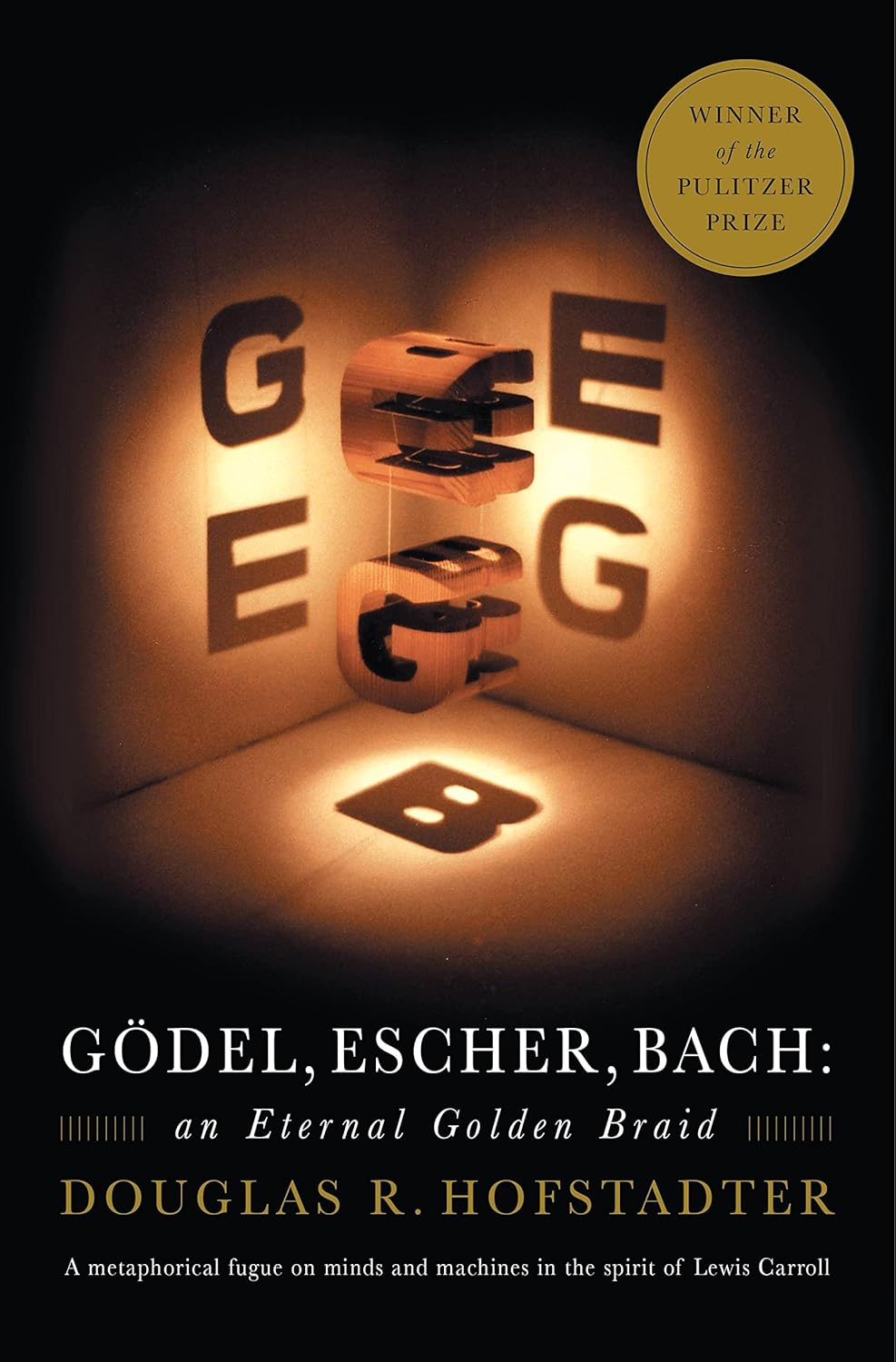
This week’s review is on Godel, Escher, Bach: an Eternal Golden Braid by Douglas Hofstadter.
A comprehensive review of Godel, Escher, Bach: an Eternal Golden Braid is beyond my technical scope. You can tell that it is Hofstadter’s passion project – his art, voice, and crafting shine through in seeking to communicate an idea. An idea about “what is a self, and how can a self come out of stuff that is as selfless as a stone or a puddle” (P-2). Of course, this journey is deeper than that and makes this large book worthy of reading, playing with, and contemplation.

The book alternates between dialogues set up to explore a concept in conversation and exposition to organize, describe, and inform on each of those. These wind together creating a tighter connection between reference and self-reference, components and wholes, parts of a set and a whole across genres, topics, and fields. If that sounds dry, this book is anything but, for Hofstadter’s joy and sense of play creates puzzles, connections, humor, and interest across the text. Even if some of the artificial intelligence aspects require updating in the age of GPTs, the essential essence of what being is and how it arises pertains to the modern moment just as well as it did decades ago. (In fact one can engage with the intellectual children of Hofstadter across the modern world).
That being said, all the topics and fields are covered in short, if not shallow form – so true philosophers, musicians, biologists, and the like may find their own field given short shrift. It is the braiding of these together that assembles a deeper conception of self. And in a post-modern way (echoing to some extant works like House of Leaves), Hofstadter presents the idea that “content is inseparable from form…semantics is of a piece with syntax” (P-12). This construction and the dialogues better illustrate the questions around meaning and form; than simple exposition. The inclusion of art and music similarly reinforce questions around rules, formality, and systems.
The other major lacking space is engagement with deeper philosophical and theological concepts — something far outside the background of Hofstadter, presumably. This neglect is not conspicuous but such engagement in concepts would have deepened the text in a constructive way. Especially in light of Bach’s rich connections to theology and the ongoing discussion of Zen Buddhism, such inclusion would have been helpful.
Although the book offers little in terms of practical support for leaders or dealing with AI, the joy and downright fun of the text makes it a worthy read.
Godel, Escher, Bach: an Eternal Golden Braid by Douglas Hofstadter.
Rating: 5/5 Stars
Good For: Those wanting a little music theory, a little math, a little art, a little computer science, and a little philosophy mixed together.
Best nugget: The discussion of the dog and bones as an example of problem reduction.
Please note: As an Amazon Associate I earn from qualifying purchases. However, I am not paid to provide reviews or use content.
Leave a Reply