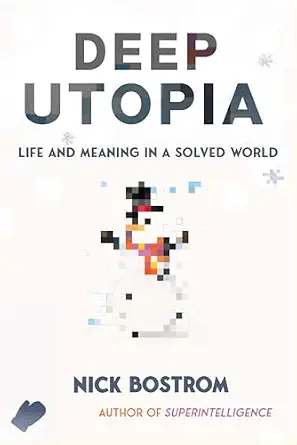
This week’s review is Deep Utopia: Life and Meaning in a Solved World by Nick Bostrom.
Oxford’s Nick Bostrom has become the world’s most cited philosopher by gaming the system using articles easily cited by arXiv dealing with artificial intelligence and its implications for humanity. I have not read his previous work, 2016’s Superintelligence – which is rumored to show the dark side of advanced AI. Deep Utopia instead aims to say – if AI solves all of our contemporary problems, eliminating work, challenge, and disease; what does that mean?
Of course, in this, Bostrom is dealing with the legacy of philosophy as a whole and its investigation into what is the good life. However, his treatment seems rooted in the contemporary world (although he is not a “utilitarian, although I’m often mistaken for one” (11)) and, as such, beyond thought exercises for undergraduate students not cool enough to invite to parties but who have friends enough to talk to about such things, fails to reach deeper conclusions, even while he succeeds in presenting the utopia as a real place.

Bostrom’s work begins its struggles in its inherent construction- a series of “lectures” of six days interspaced with insipid extracts – an animal fable and a dialogue among friends (the most relevant and most wasted). Whereas the charm of the interludes in the work of Hofstadter is the interludes and their illumination and elucidation of the concepts discussed; Bostrom’s feels like a padding and a raised eyebrow nodding to his own intelligence. The six days, however, do have their own themes and it is here that an editor could have helped produced a valued text.
The challenge (especially in light of the “hugging face” incident) is clearly laid out: “at some point, somebody, or all of us, might be confronted with choices about what kind of future we want” (4). In a world of “material abundance” (5), we may lose the incentive to work (“income” or “because working is an intrinsically values activity” [8]). Bostrom acknowledges that he is not the first philosopher to explore to world beyond work (noting that “landowning aristocrats of the pat correspond to the rich future human population” (20)). However, his approach seems shallow in its engagement with the literature and ultimately, the first section looks briefly at these larger implications.
The second section dives deeper into how AI could radically create utopia – not just eliminating work but altering who and what we are as humans. Bostrom level sets by discussing some of the limits that we face as organic and (semi) rational creatures. some will “be overcome with sufficiently advanced technology” (81). Others – such as status – may remain in such a way as humans find it necessary to shun machine alternatives. In general, however, humans would be come the so-called “superfluous man” (‘Handout 8’) forcing us to adapt and develop “a culture that is better suited for a life of leisure” (111).
This question of what we would do when machines can do everything, better than us, and even change us is the heart of the book. Here he defines such a world as “one in which it is easy to meet everybody’s basic material needs as traditionally conceived–food, housing, transportation, etc. We may toss in schools and hospitals and some other such services into the mix as well” (120) and into “post-work utopias…a society that has achieved full automation and thereby eliminated the need for human labor” (121). Bostrom here also makes the point that we are advancing into this world economically in the west to some degree (but does not strike at the disparities needed in such a capitalistic world to support it). These thought experiments are certainly interesting in a dorm room intellectual way: why workout if a machine can change the very structure of your body, even providing the endorphins that contribute a rush, at a push of a button? Why parent when “robotic caregivers with superhuman parenting skills…perfectly lifelike in appear and behavior…made to appear to the child indistinguishable from their actual biological parents” exist to change diapers, discipline, and play (134-135). This sets up the beginning of his discussion of meaning.
We must transition from doing things for instrumental reasons to “autotelic” reasons (147). Hedonism does not seem to be the answer; perhaps it is doing things on “hard” mode? Even beyond the idea of experiences; could life be interesting, fulfilling, and meaningful (194)? Interestingness then rests on those things that are “contained” and “contributed” (229). The discourse on interestingness (Thursday) was not very interesting; but Bostrom’s turn to fulfillment and meaningfulness do add some to the thought experience.
The philosophical examination of “fulfillment” rests in an examination of whether it means “of our capacities, of the highest of our capacities, or of our aspirations, or of our true individuality” (294). Here, Bostrom comes close to looking at the idea of vocation (Bostrom says “mission”) – one that probably would have been more deeply discussed with a someone from a deeper philosophical and theological background. Are these “agent-neutral” or “agent-relative” – are they dependent on who the person is or not? Handout 18’s discussion of what these may look like contains fertile ground for science fiction writers (or was mined from their works already). The chapter ends with a unique interlude examining a company dedicated to the mission of supporting an HVAC machine. Again, fodder for coffeehouse discussion, but one that can analogize to both supporting machine-“life” or human life.
The final section, focuses on the idea of meaningfulness. Here – the discussion is rooted in the idea of “the good, the true, and the beautiful” or Mandela, Eisntein, and Dostoevsky (386). These concepts are poked, prodded, and stretched across the realm of contemporary philosophy and ultimately end up being unanswered in a Sopranos-esque ending.
Oddly, Bostrom does not engage with the most famous fictional representation of such a universe – Iain M. Banks’ The Culture. Ultimately, I find Banks’ fictional engagement with such a utopia more engaging than Bostrom’s dialectics. In the end, for an undergrad moving beyond Ayn Rand, the book might be worthy of discussion, for the techbro who struggles to read real literature, it is worth purchasing; but for serious thinkers, Deep Utopia is neither deep not utopic.
Deep Utopia by Nick Bostrom.
Rating: 2.5/5
Best Nugget: Technology could get really good; what do we do then?
Good for: Techbros who don’t read or think much.
Leave a Reply